Modern vs. Contemporary Ceiling Fans: What's the Difference (and Which Fits Your Room)?
If you were shopping for a new ceiling fan and saw one labeled modern and another labeled contemporary, would you know the difference?
Most people often use these words interchangeably, but in the world of interior design, you may be surprised to learn that they mean two very different things. The term “modern” within interior design circles actually refers to a specific design or style. On the other hand, when someone refers to “contemporary design,” they are referring to any design styles that reflect what is “trendy” or “popular” today.
Knowing the difference between the two terms is important when you shop for modern ceiling fans or contemporary ceiling fans. If you understand what makes each style unique, you can pick a fan that aligns with the rest of your home or office decor.
What Makes Modern Ceiling Fans Modern?
Understanding modern ceiling fans starts with knowing a bit about the design movement that inspired them.
In the early 1900s, designers began to keep things simple. They shifted away from the carved woodwork and elaborate details of Victorian furniture. Instead, they chose more practical designs that were less expensive to make and faster to produce.
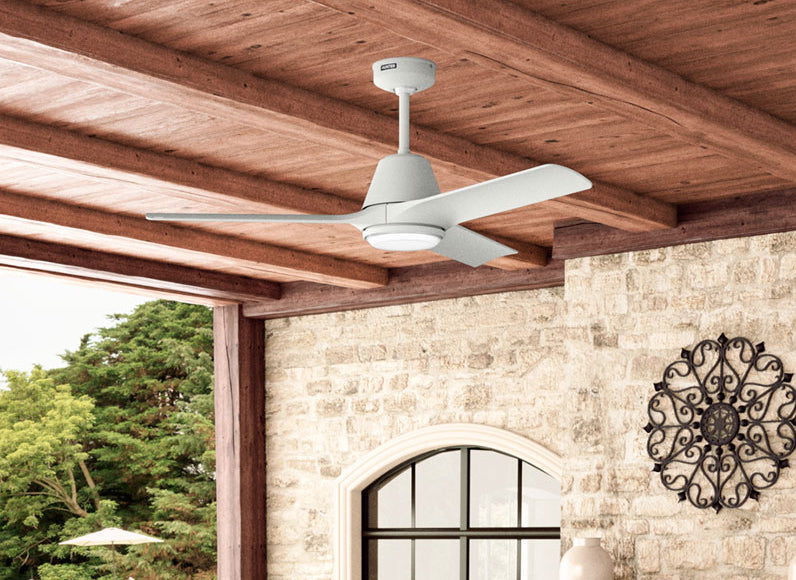
You can see this same idea in modern ceiling fans today. Imagine a fan with three long blades stretching out from a rounded motor housing, without any decorative brackets or fancy metalwork. The blades may be straight or slightly curved, but their shape stays simple.
Modern ceiling fans with lights also follow this style. Many have a single round light fixture close to the motor housing instead of several separate glass shades.
This influence is also clear in mid-century modern ceiling fans, inspired by the furniture and architecture of the 1940s, 1950s, and 1960s. These fans often use warm wood finishes, gently tapered blades, and rounded shapes that match the style of that time.
What Makes Contemporary Ceiling Fans Different?
Contemporary ceiling fans can look pretty odd compared to the fans you grew up with. You might see one with a glowing ring around the motor or a design that makes you wonder how the blades even move air.
There’s just no end to the types of creative designs you might find when shopping for contemporary ceiling fans. Their looks can vary between extremes, but here are some features to look for:
- Unusual blade shapes: Rather than the usual rectangular blades, fans may have blades shaped like curved airplane wings, wide leaves, or narrow propellers with a slight twist.
- Unexpected materials and finishes: These fans may mix natural wood blades with a Matte Black motor housing, or mix a variety of finishes together for a more unique look.
- Creative lighting designs: Many contemporary ceiling fans with lights use circular LED panels, glowing rings, or lighting that’s built right into where the motor is.
- Distinctive motor housings: Instead of the usual rounded shape, contemporary fans may have a slim cylinder, use pointed geometric shapes, or include a housing that almost disappears into the blades.
Contemporary ceiling fans provide homeowners with the freedom to mix eclectic styles and influences from across different time periods. A ceiling fan might borrow elements of modern design while simultaneously introducing a fresh new look that feels trendy in homes today.
So how can you tell them apart? You can't always. A fan could easily fit into either category, depending on the design details - but it’s a great talking point when you know the difference.
Modern or Contemporary: Which Is Right for Your Home?
If you’re trying to decide whether your home décor skews more modern or contemporary, check out Hunter's How to Choose a Ceiling Fan guide or watch our How to Match a Ceiling Fan to Your Room video for design inspiration.
Start by taking a look around your house and thinking about the types of furniture, colors, and styles that appeal to you. Do you gravitate more toward contemporary décor or prefer mid-century pieces? Are you drawn to dark or light colors, wood or metallic finishes?
For example:
Living Rooms
Say you redecorated your living room a few years ago. It’s filled with beautiful walnut furniture and pieces that are inspired by design trends from the 1950s. If you need to add a ceiling fan, a mid-century modern design could be a great match.
On the other hand, maybe you redecorated your living room gradually over the years. You might have an old leather recliner alongside a newer sectional couch, with a coffee table your grandmother left you in her will. If you need to add a ceiling fan, a contemporary fan could be a great fit. Much like your living room, contemporary design can bring it all together, with influences from different styles and eras.
Kitchens and Dining Rooms
In kitchens, make sure your contemporary ceiling fan has enough clearance around existing fixtures and cabinetry. You don't want the blades interfering with pendant lights or cabinet doors when they're opened. If the lighting in your kitchen is sufficient as is, a contemporary ceiling fan without lights may be exactly what you need (and won’t add yet another light in an area that may already feel cluttered with appliances or other items). In dining areas that could use some added lighting, a contemporary ceiling fan with lights will add breezes plus brightness above that can be dimmed as desired for eating in or getting everyday tasks accomplished.
Bedrooms
When choosing a modern ceiling fan for your bedroom, you’ll want to decide if a model with or without lights will be a better fit. For example, if your bedroom currently has one primary overhead light, a modern ceiling fan with lights may be a good choice for two-in-one form and function.
On the other hand, if you already have recessed lighting or bedside lamps to illuminate the room, you may want to go with a modern ceiling fan without lights so as not to clutter up the space above. (Lamps may also be a good option for times when you want to create a softer mood in the room, too.)
Make sure your fan is the right size by taking your bedroom’s measurements into account. And if airflow is a priority, consider a Hunter fan backed by our SureSpeed® Guarantee, which delivers powerful air movement.
Finding the Perfect Ceiling Fan for Every Room
For homes with modern or contemporary décor, Hunter has ceiling fans to complement every room. With a history of craftsmanship dating back to 1886, we’ve been providing customers with high-quality fans that match the style of their homes for generations. To help you find the perfect ceiling fan for every room, you can:
- Shop by décor style using our Contemporary Ceiling Fans and Mid-Century Modern Ceiling Fans.
- Learn how Hunter's SureSpeed® Guarantee delivers powerful airflow, with over 33% more air velocity than leading competitors, based on Hunter's testing.
- Use Hunter's Ceiling Fan Size Guide to determine the right blade span for your room, especially if you're shopping for a larger living area.
There are no hard-and-fast rules when it comes to décor; play around with different shapes, styles, and finishes to find a ceiling fan (and décor style) that makes you feel happy to come home!
Frequently Asked Questions About Modern and Contemporary Ceiling Fans
1. What’s the Difference Between Modern vs. Contemporary Styles?
Modern ceiling fans usually have really simple designs with basic shapes and very little elaboration or decor. Contemporary fans show off styles that are popular right now. It’s not uncommon for past designs to become popular again, so sometimes modern and contemporary styles overlap when talking about ceiling fans (or interior design in general).
2. Are Modern Ceiling Fans More Expensive Than Contemporary Ceiling Fans?
Not necessarily. The price of a ceiling fan depends more on its construction and features than its decorating style. A fan with smart controls or integrated lighting may cost more than a basic model, regardless of its appearance. Compare the features you actually need before deciding how much to spend.
3. Should My Whole House Be Either Modern or Contemporary Styled?
Not at all! Your home should reflect what you like, and there's no rule saying every room needs to follow the same decorating style.
If you love what's popular right now, contemporary ceiling fans, might be right up your alley. That could mean a brand-new design you've never seen before or an older style that's making a comeback. If you prefer a simpler look without elaborate decorations or fancy details, modern ceiling fans may be more your taste.
And there's nothing wrong with mixing the two! Maybe you love mid-century modern ceiling fans because you have a soft spot for vintage furniture, but your recently remodeled kitchen feels more contemporary. Go with what makes you happy, and with what feels uniquely like you!
4. Do contemporary ceiling fans provide better airflow than modern ceiling fans?
Just because a ceiling fan is labeled “contemporary” - that doesn't mean it moves more air than a modern fan. Contemporary describes how the fan looks, not how well it performs. The amount of air it moves depends largely on its motor, blade design, size, and speed. If you want to know how two fans compare, always check their CFM ratings. CFM stands for cubic feet per minute and tells you how much air a fan can move at a given speed.
5. Are three-blade modern ceiling fans better than five-blade fans?
Not automatically. A three-blade fan can circulate the air in your room just as well as a five-blade fan; it just depends on how it's engineered. Blade count is often more useful as a design preference than a reliable indicator of performance.
6. Can contemporary ceiling fans work with smart home technology?
It’s definitely possible. We offer compatible fans with HunterSMART™ technology, which lets you control them through a variety of smart devices. Be sure to check the product description for specific compatibility and available features that you may need.
7. Can I add a light kit to a ceiling fan without lights?
Possibly! First, you'll need to check if your ceiling fan is designed to accommodate a light kit. Many fans are, but not all of them. If yours is compatible, you can browse Hunter's ceiling fan light kits to see which options will work with your model.
8. Do modern ceiling fans work on sloped ceilings?
Yes! Have a vaulted or angled ceiling? Many modern ceiling fans can be installed on them. Just pay attention to how steep your ceiling is. You may need an angled ceiling mounting kit and a longer downrod to get your fan hanging at the right height. Check your fan's installation manual before getting started.
9. Can contemporary ceiling fans be installed outdoors?
Yes, as long as they're rated for outdoor use. Hunter’s damp-rated fans are best for covered outdoor areas, while our wet-rated fans can be used in more exposed locations. Indoor-rated fans should never be installed outdoors.
10. How long should a modern or contemporary ceiling fan last?
A well-made ceiling fan can provide years of comfort, especially when it's properly installed and maintained. Hunter has been making ceiling fans since 1886, and we take great pride in building fans that last. In fact, eligible Hunter ceiling fans come with a limited lifetime motor warranty. Check the warranty for your particular model to see exactly what's covered.
The Bottom Line
If your living room has furniture and designs inspired by the past, you might love our modern ceiling fans. If you prefer current styles and furnishings, our contemporary fans could be a better fit. Some fans even blend both styles. In the end, choose the fan that fits your space and keeps your room comfortable.
Browse Hunter's ceiling fans with lights, or find the perfect fan using our ceiling fan selector!