A sunroom is a great addition to your home to entertain, relax, and have extra living space. But it can get steamy in there! When the mercury rises, these areas can get uncomfortable if you don’t have the proper cooling solutions for a sunroom.
While some people may opt for an air conditioner, many others may not want to do this. Luckily, there are other options to cool a sunroom without AC. From adding insulation to installing outdoor ceiling fans, there are several sunroom cooling solutions we know you’ll love!
Challenges of Cooling a Sunroom in Warm Weather
Cooling a sunroom in the warm weather can be challenging because of the way many sunrooms are designed. Many sunrooms are made to be cozy, so natural air circulation is not optimal.
Here are some common challenges people face when they want to cool a sunroom without AC:
-
The surrounding glass can make the temperature rise faster than other areas of your home.
-
Depending on where your sunroom is located, it may be in the path of direct sunlight for most of the day, making it uncomfortable.
-
If your sunroom has single-pane glass or non-insulated windows, they can directly transfer outdoor heat inside. This makes your sunroom feel hotter than the rest of our house.
-
Inadequate circulation can also create stuffy air, making the room feel uncomfortable.
Your sunroom should be a place of relaxation, not a sauna! If you experience one or several of these issues, it’s time to explore different sunroom cooling solutions.
Ways to Cool a Sunroom Without AC
Simply because you don’t want to install a window AC unit in your sunroom doesn’t mean you have to sweat it out. There are several other options to cool a sunroom without AC
Consider Insulation
When people think about insulation, they think about keeping warm. But, insulating your sunroom can help to keep it cool as well. Insulation prevents the outside heat from getting in. This keeps the room comfortable without the use of an air conditioning unit, which can make your electricity bills rise.
Insulation also helps to eliminate the greenhouse effect. Insulation acts like a wall to prevent solar radiation from getting inside and creating an uncomfortable area.
Get New Windows
Older windows allow heat to transfer into your sunroom. New windows with specialized coatings can reflect solar infrared heat away from the house while allowing visible light in. You may also want to look at upgrading to dual-pane windows. Two panes of glass can create a barrier that reduces the transfer of outdoor heat, helping to cool a sunroom without AC.
Believe it or not, as your windows age, they become less efficient at keeping the elements outside and you warm or cool inside.
Check for Seal Leaks Around the Windows
If new windows are not an option, you can still check for seal leaks around the windows. If you have leaks, they can let unnecessary hot air into the sunroom. By fixing these leaks, you can help to keep the warm air out of your sunroom. And, as an added bonus, you’ll probably notice your window frames will stay cleaner.
Install the Right Ceiling Fan for Your Sunroom
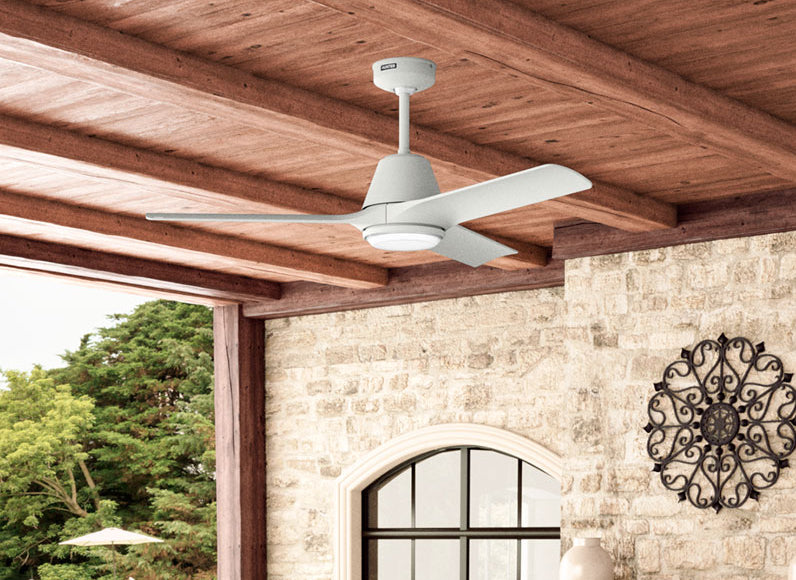
Installing a ceiling fan for a sunroom is one of the most effective ways to improve comfort during hot weather — especially when you want to cool a sunroom without AC.
Unlike air conditioners, ceiling fans do not lower the room’s actual temperature. Instead, they improve airflow and create evaporative cooling by moving air across the skin. This process helps moisture evaporate more quickly, making occupants feel significantly cooler.
When selecting a ceiling fan for a sunroom, consider the following:
Airflow (CFM):
Look for high airflow performance measured in cubic feet per minute (CFM). Larger sunrooms benefit from fans with higher airflow.
Blade Span:
-
Up to 100 sq ft → 36–44 inches
-
100–225 sq ft → 44–52 inches
-
Over 225 sq ft → 52 inches or larger
Proper sizing ensures balanced air circulation. Use our guide on how to measure a ceiling fan for further instruction and help.
Moisture Rating:
-
Enclosed sunroom → Damp-rated ceiling fan
-
Screened or exposed sunroom → Wet-rated ceiling fan
Sunrooms often experience higher humidity due to glass condensation and temperature fluctuations. Choosing the correct rating protects the motor and internal components.
Energy Efficiency:
ENERGY STAR® certified ceiling fans use significantly less electricity than window AC units, helping lower energy bills while providing continuous airflow.
An additional benefit is year-round functionality. Many ceiling fans feature a reversible motor, allowing you to circulate warm air downward in winter — providing practical heating and cooling solutions for a sunroom throughout the year.
When choosing the best ceiling fan for a sunroom, prioritize high airflow (CFM), proper blade span, and the correct moisture rating.
Plant Trees or Shrubs Around the Sunroom
While you don’t want to plant too many trees to block all of the sun, you may want to consider planting some trees to minimize the sun’s impact. This can help shade the room in the summer while allowing light in during other seasons.
Benefits of Cooling a Sunroom Without AC
When you choose to cool your sunroom without AC, you can enjoy several benefits. These include:
-
Lower Energy Bills
AC units can drive up energy bills. When you choose to cool your sunroom without it, you don’t have to worry about high bills, and can still enjoy a comfortable setting.
-
Improved Airflow
Installing ceiling fan and using other methods can help to improve ventilation in the room. By eliminating trapped air, you can make the room more comfortable at an affordable level.
-
Reduced Noise & Pollution
Many AC units are very noisy, creating an unpleasant environment. By not using a window AC unit, you can reduce noise and pollution in your neighborhood.
-
More Aesthetically Pleasing
Sometimes an AC unit in the window can create a look that’s not aesthetically pleasing. Maintain the look of your sunroom by choosing other methods to stay cool.
FAQ About How to Cool a Sunroom Without AC
Can a ceiling fan lower the temperature in a sunroom?
A ceiling fan does not lower the air temperature in a sunroom. Instead, it improves perceived cooling by increasing airflow and accelerating evaporation on the skin. This can make the space feel several degrees cooler even though the thermostat remains unchanged.
Should I use a damp-rated or wet-rated ceiling fan in a sunroom?
If your sunroom is fully enclosed and protected from direct moisture exposure, a regular indoor ceiling fan is typically sufficient. However, if your sunroom is screened, exposed to humidity, or may encounter moisture from open windows, a wet-rated ceiling fan offers additional durability and protection.
What type of window dressings can help to cool my sunroom without AC?
Consider installing reflective blinds. These can help to keep some of the sunlight out of your sunroom. Also, keep blinds drawn in the day to minimize the sun’s effect on the room’s temperature.
Should I extend my main home's HVAC system to keep my sunroom cool?
It is often not recommended to extend existing ductwork. It can overwhelm your current system and be very inefficient.
How warm can my sunroom get?
This will depend on the temperature outside. But some sunrooms can reach and exceed 100 degrees Fahrenheit.
What size ceiling fan is best for a sunroom?
The ideal size depends on square footage. Most average sunrooms (150–250 sq ft) perform best with a 52-inch ceiling fan. Larger spaces may require multiple fans or a model with higher airflow output to ensure proper circulation.